12. System Context - Hardware Token/Capsule Server
The CDOC2 system operates in two distinct deployment contexts. This page describes the Hardware Token/Capsule Server context; for the Smart-ID/Mobile-ID context, see SID/MID. Both contexts share the CDOC2 reference library and CDOC2 CLI client as common components.
Note: DigiDoc4 is the primary end-user client application through which most users interact with CDOC2. However, DigiDoc4 is not part of the CDOC2 system scope defined here, as its architecture and documentation are maintained separately.
12.1 Overview
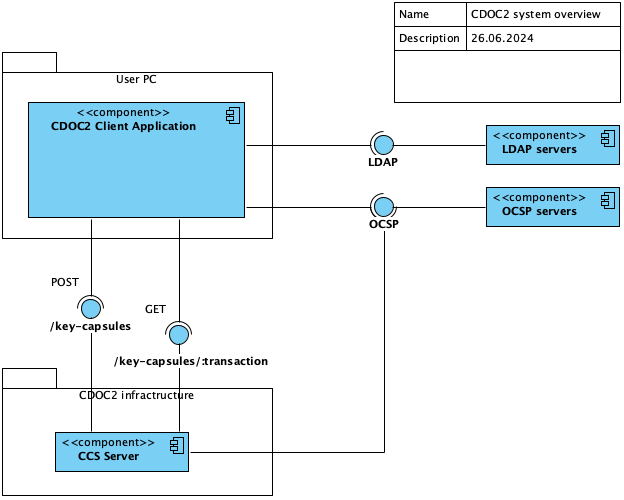
In the Hardware Token context, encryption and decryption flows rely on the Recipient holding a hardware security token (e.g. an Estonian ID-card). Key material is stored as a Server Capsule and mediated via a CDOC2 Capsule Server. Unlike the SID/MID context, no additional authentication servers or key share distribution are involved - the Recipient's hardware token provides the cryptographic identity directly.
12.2 Primary Components
- CDOC2 Capsule Server (CCS): Stores Server Capsules and mediates them between Sender and Recipient, used by CDOC2 clients such as the reference CLI client and DigiDoc4. Every CDOC2 Capsule Server uses a local database component as well.
12.3 Shared Libraries
- CDOC2 Reference Library: used by CDOC2 servers and the CLI client.
- CDOC2 CLI Client: a command-line Java application that implements all CDOC2 end-user use cases, but without a graphical user interface.
12.4 External Systems
The CDOC2 system depends on the following external components and services.
- OCSP servers (SK ID Solutions, Zetes): Provide certificate validity checking for ID-card certificates.
- LDAP servers (SK ID Solutions, Zetes): Used by CDOC2 client applications to search for Recipient certificates prior to encryption.